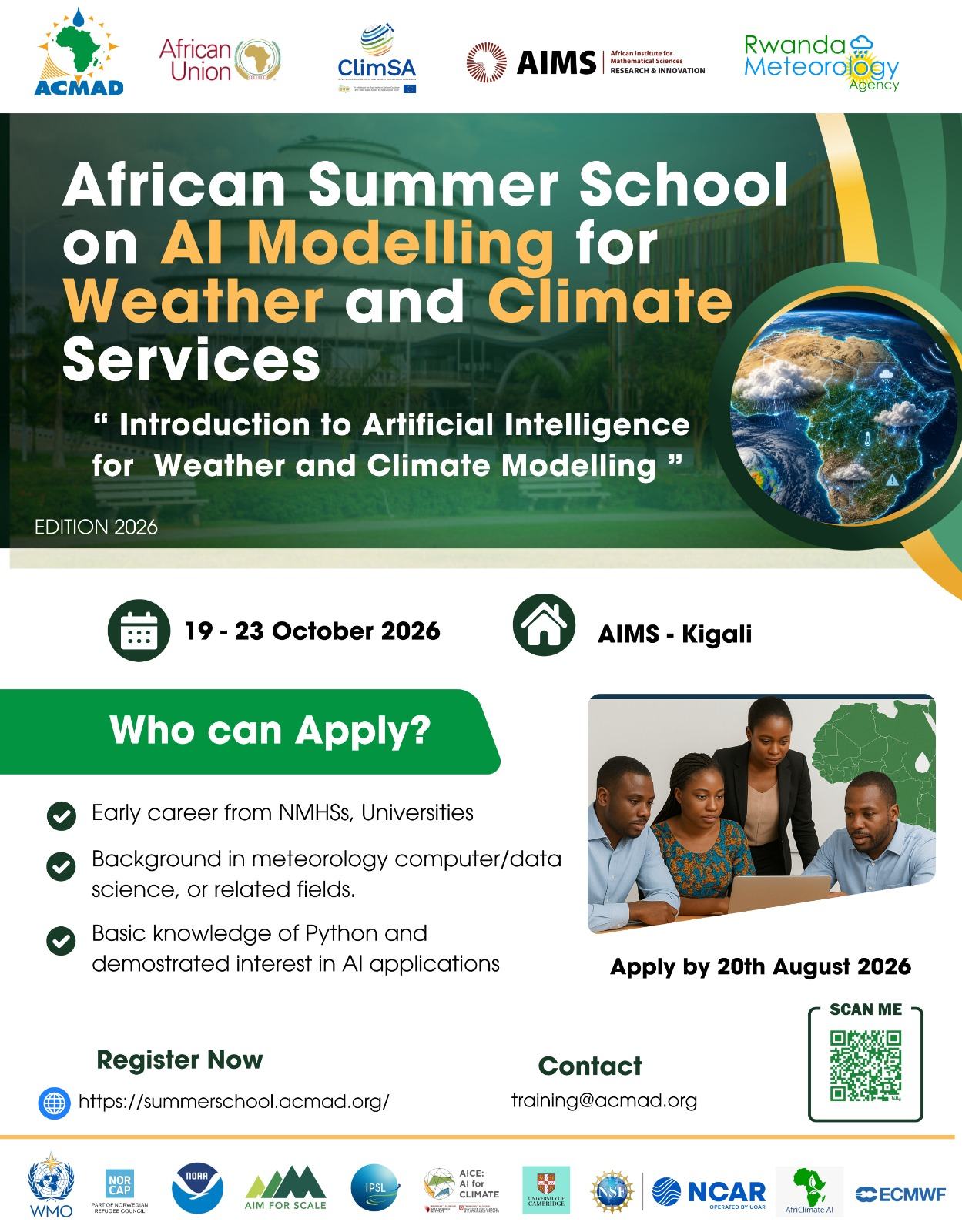
African Summer School on Artificial Intelligence for Weather and Climate Modelling 2026
19 Oct 2026 – 23 Oct 2026
About the event
Event overview
Background and Rationale
While numerical weather prediction and climate models remain central to weather and climate services, Artificial Intelligence and Machine Learning are rapidly emerging as complementary or surrogate tools for forecasting, downscaling, bias correction, extreme event detection and impact-based early warning. AI and machine learning approaches can be particularly useful in the African context because they can complement dynamical models, support post-processing and downscaling, and enable the development of practical tools where computing resources, dense observational networks and specialized modelling capacity remain limited. Integration of AI in ECMWF operational weather prediction is as skillful as the traditional dynamical model or even better (Rabier F. et al. 2026). However, many African institutions still face capacity gaps in applying these methods operationally, including limited access to AI expertise, large-scale climate datasets, computing workflows, and practice skills. Through its continental mandate and strategic plan, ACMAD aims to promote coordinated African capacity in AI-enabled weather and climate modelling across the continent. The 2026 AI theme is therefore timely. It will help ensure that African NHMSs, RCCs, research institutions as well as sectors are not only users of externally developed AI systems, but active contributors to their design, validation, adaptation and operational use in African contexts.
Methodology
The Summer School will combine expert-led lectures, keynote sessions (example of AI modelling), hands-on coding workshops, peer learning and group project work. Training will use real African weather and climate datasets to ensure practical relevance. Participants will work in teams to develop prototype solutions addressing real-world forecasting, climate modelling, extreme event or impact-based early warning challenges.
Objective:
The overall objective is to strengthen Africa’s capacity to apply AI in climate modelling to improve climate information services leading to disaster risk reduction.
Specific objectives:
- Introduce participants to the concepts and principles of AI and Machine Learning for weather and climate modelling.
- Build understanding of how AI can complement existing forecasting and climate service systems.
- Expose participants to practical examples of AI applications in weather and climate.
- Provide hands-on experience with AI/ML workflows using weather and climate datasets.
- Promote collaboration between NHMSs, RCCs, academia and sectors through a sustained community of practice.
Expected Learning Outcomes :
By the end of the Summer School, participants will be able to :
- Explain the role, opportunities and limitations of AI in weather and climate services.
- Understand the steps involved in preparing weather and climate data for AI/ML workflows.
- Describe selected AI applications in climate forecasting, bias correction, downscaling and early warning services.
- Develop an AI-based example relevant to African weather and climate services.
- Present a practical plan for applying the acquired knowledge within their institution.
Expected Output and Impact
- Training curriculum and teaching materials developed and archived at ACMAD eLearning
- Improved capacity of African institutions to understand and use AI climate model with at least 30 participants trained
- Development of AI-based prototypes for climate modeling
- Post-training community of practice and mentorship plan launched.
Target Participants:
The Summer School will target 30 trainees drawn from African NMHSs, RCCs, universities, and relevant climate sectors. Participation may be supported through scholarships, institutional sponsorship, partner support or self-funding, depending on available resources. Selection will prioritize gender balance, regional representation, early-career professionals and applicants with a clear institutional role in weather, climate or early warning services.
Admission Criteria
1. Affiliation with an NMHS, RCC, university, school, research institution or climate-related technical agency.
2. Background in meteorology, climatology, hydrology, computer science, data science, geography or related fields.
3. Basic knowledge of Python or willingness to complete a pre-course Python module.
4. Demonstrated interest (project) in AI applications for weather, climate or early warning services.
5. Institutional support or a clear plan for applying the training after the Summer School.
6. Commitment to participate in all sessions and group project activities.
7. Women and early careers are encouraged
Self-funded or sponsored participants:
We are open for some self-funded participants and they may contact training@acmad.org for more information.
Sustainability and Follow-up
The Summer School will not be treated as a one-off training event. ACMAD will establish a follow-up mechanism through an online community of practice, shared training resources and mentorship sessions. Lessons from each edition will inform the theme and curriculum of subsequent years, creating a continuous continental learning platform on emerging priorities in weather, climate and early warning services.
Refrences
Rabier F., A. Brown, M. Chantry and F. Pappenberger, 2026: “Weather forecasting in a changing climate: the rise of AI and Machine learning?”, Journal of the European Meteorological Society, Vol. u4, 100040, ISSN 2950-6301, https://doi.org/10.1016/j.jemets.2026.100040.
Moldovan, G. et al., 2026 : “AIFS Single 1.1.0: an update to ECMWF's machine-learned weather forecast model AIFS”. Geosci. Model Dev. Vol 19, https://doi.org/10.5194/gmd-19-4703-2026