HeatEWS Project: Getting Ahead of Extreme Heat in Communities Hosting Forcibly Displaced People
12 Oct 2026 – 15 Oct 2026
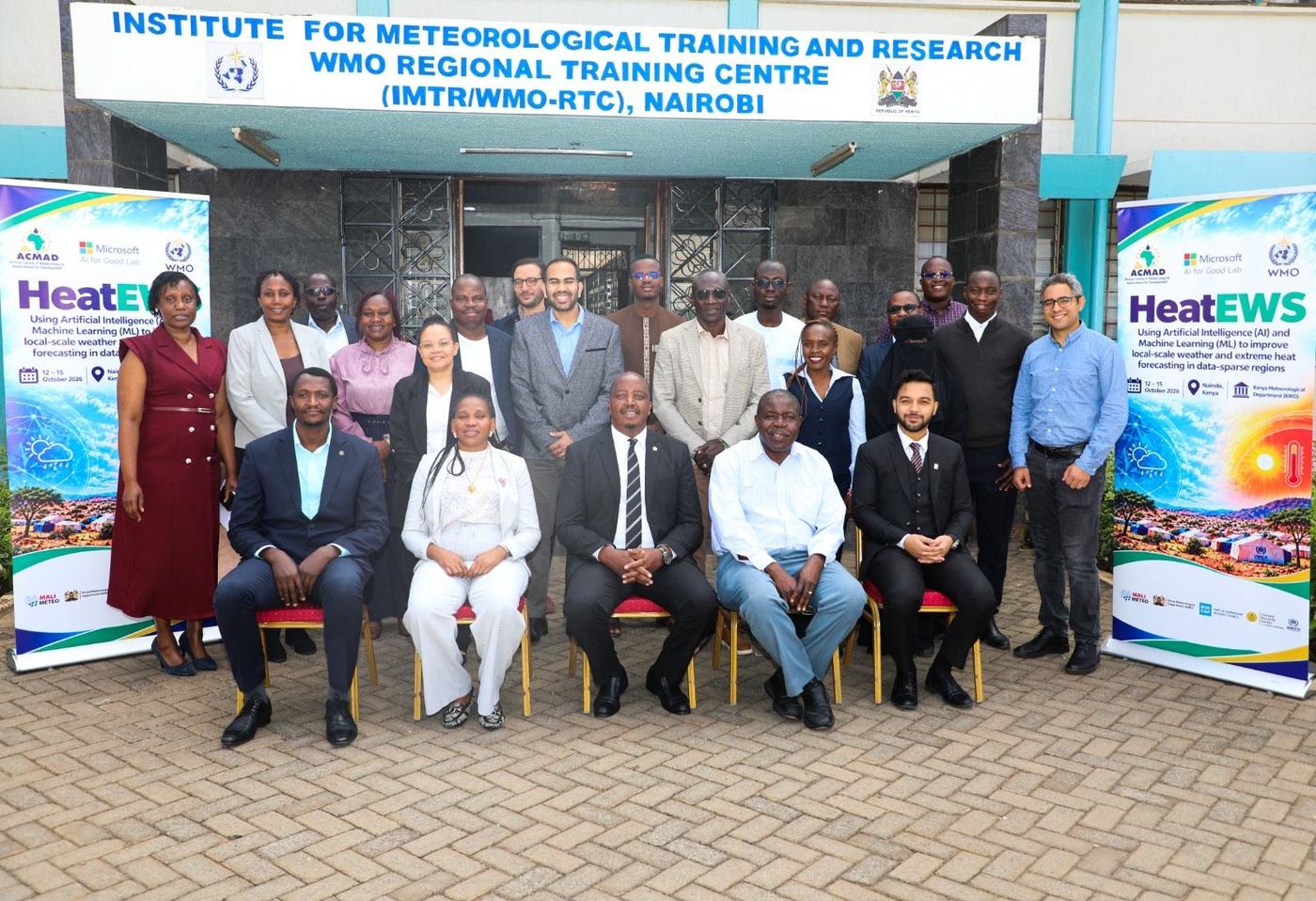
About the event
Event overview
Workshop theme: Using Machine Learning to Improve Local-Scale Weather and Extreme Heat Forecasting in Data-Sparse Regions
Background and Rationale
Extreme heat is becoming an increasingly serious risk to health, livelihoods, water access, shelter safety, and essential services across Africa1. These risks are particularly severe in communities hosting forcibly displaced people, where exposure to heat is often combined with limited infrastructure, constrained access to water and health services, fragile shelters, and limited local observational data2. The HeatEWS project, “Getting Ahead of Extreme Heat in Communities Hosting Forcibly Displaced People,” is designed to demonstrate how machine learning can support local-scale extreme heat early warning in data-sparse humanitarian contexts. The project focuses on improving the local relevance of weather forecasts by combining global forecast products, reanalysis datasets, station observations, and machine learning-based post-processing. The pilot work is centred on the Gao region of Mali, including the Cité Nata site near Gao, where displaced and vulnerable populations are exposed to high heat risk. A central challenge addressed by the project is that global and regional forecast products are often not directly suitable for local decision-making. They may have systematic biases, coarse spatial resolution, and limited ability to represent local conditions, particularly where station observations are sparse or incomplete. Machine learning provides an opportunity to improve the usefulness of these products by supporting bias correction, local-scale prediction, downscaling, forecast verification, and the generation of impact-oriented indicators. Within the project, machine learning approaches are being explored to improve daily maximum temperature forecasts, reduce forecast bias, evaluate forecast skill by lead time, and support the development of threshold-based or percentile-based extreme heat indicators. These methods are relevant not only for extreme heat but also for broader weather forecasting applications in data-sparse regions, including rainfall, heavy rainfall, flood-related variables, and other high-impact weather conditions. This four-day training workshop in Nairobi will support the capacity-building component of the project. It will bring together forecasters and technical staff to build practical skills in applying machine learning to weather forecasting problems. The workshop will use HeatEWS as a practical case study. The training will be hands-on and operationally oriented. Participants will work through practical examples involving weather observations, global forecasts, forecast errors, bias correction, verification, and the design of locally relevant forecast indicators. The workshop will also strengthen collaboration between the participants around the use of artificial intelligence and machine learning for early warning in data-sparse African contexts.
Overall Objective
The overall objective of the workshop is to strengthen the capacity of weather forecasters and technical staff from Mali Meteo and the KMD to understand, apply and evaluate machine learning methods for improving weather forecasts in data-sparse regions.
Specific Objectives
- Introduce the main concepts of machine learning relevant to operational weather forecasting and forecast post-processing.
- Build practical skills in preparing weather, climate, and forecast datasets for machine learning applications.
- Demonstrate how machine learning can be used for forecast bias correction and local-scale forecast improvement.
- Use the HeatEWS project as a practical case study for local-scale extreme heat forecasting in a data-sparse humanitarian setting.
- Explore the development of locally relevant weather and extreme heat indicators using fixed thresholds and percentile-based approaches.
- Support exchange between Mali Meteo, KMD, UNHCR and ACMAD on operational needs, data availability, and future collaboration.
- Identify follow-up actions for integrating machine learning approaches into national and regional forecasting workflows.
Expected Results
- Improved understanding of machine learning concepts and their relevance to operational forecasting.
- Practical experience in preparing weather observations, reanalysis datasets, and global forecast products for machine learning.
- Understanding of how to evaluate forecast performance by lead time, location, season, and threshold.
- Draft prototype workflows for applying machine learning to selected forecasting challenges in Mali and Kenya.
- A shared understanding of data requirements, technical gaps, and institutional needs for operational implementation.
- A set of agreed follow-up actions to support continued collaboration between ACMAD, WMO, Mali-Meteo, KMD and UNHCR.
Proposed Training Approach
The workshop will combine technical lectures, guided demonstrations, hands-on, group discussions, and applied case studies. The workshop will use the HeatEWS project as a central example of how machine learning can be applied in a real data-sparse forecasting context. Participants will learn how forecast inputs, observations, and reference datasets can be prepared and used to train, evaluate, and interpret machine learning models.