
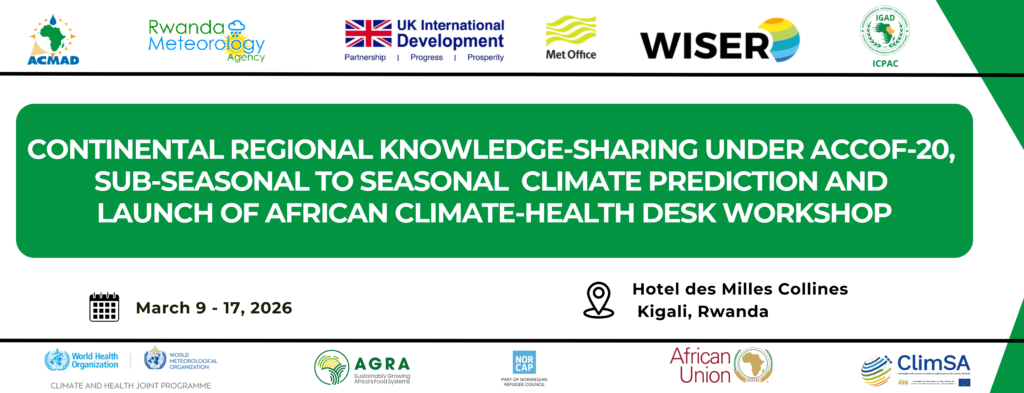
Continental RCC Knowledge-Sharing Workshop under ACCOF & S2S Climate Prediction Symposium

DATE
9–17 March 2026
Location
Kigali, Rwanda at Hotel Des Milles Collines

About Workshop
The African Continent, with abundant diverse ecosystems, rich cultural heritage, and relatively fast-growing populations, faces disproportionate burdens and risks arising from climate change-related weather events and patterns. These events cause massive humanitarian crises with detrimental impacts on agriculture and food security, education, energy, infrastructure, peace and security, public health, water resources, and overall socioeconomic development across the continent.
Between 1970 and 2019, Africa experienced 35% of weather, climate, and water-related deaths. Today, only 40% of the African population has access to early warning systems for weather, climate, and water extremes. Yet, the most recent IPCC report (AR6) projects that the frequency and intensity of such extremes will increase across Africa due to climate change, exacerbating the risks to livelihoods, ecosystems, and infrastructure due to high exposure and vulnerabilities across the continent. The increasing frequency and intensity of climate-related disasters have underscored the urgent need for effective early warning systems (EWS) and climate information services (CIS) to reduce disaster risks and build community resilience. Vulnerable populations often face limited access to actionable early warning information, especially at the last mile, where the impacts of disasters are most severe. Locally led, innovative approaches are essential to bridge this gap, enabling communities to better anticipate and respond to multi-hazard risks through impact-based forecasting.
Although African National Meteorological and Hydrological Services (NMHSs) provide weather and climate information, the quality, relevance, and delivery formats of this information often do not fully meet the needs of effective early warning. There is therefore a need to better define and specify user requirements for warning products and services to enhance community resilience through improved risk management. Once these needs are clearly identified, the corresponding products and services should be developed, validated, and operationalized to ensure they effectively support early warning and decision-making processes. Strengthening seamless prediction systems, from weather to sub-seasonal and seasonal timescales, is critical to improving preparedness and resilience. Seasonal climate outlooks are essential planning tools across Africa, where the climate is highly variable. Yet, despite their importance, these forecasts often fall short of their potential, particularly for those operating at the local level (e.g., small farm holder), where decisions are most sensitive to climatic variation.
Regional Climate Centers (RCCs), as well National Meteorological and Hydrological Services are facing challenges such as disconnect between science-based information and the actual decision-making process (i.e., how information is presented to users), existing gap between local climate action needs and the decision-making processes that govern the functioning of climate outlook forums and other relevant spaces for forecast generation and translation (i.e., what are the operational arrangements to ensure timely delivery). These challenges are met with limited operational capacity to downscale regional forecasts into nationally and locally relevant ones, including those variables that are most relevant to the decision maker.
Despite these limitations, substantial progress has been made across the continent. Regularly, the RCCs across the continent provides seasonal forecasts through the Regional Climate Outlook Forums (RCOFs) such as GHACOF (Greater Horn for Africa), MedCOF (North Africa), PRESAC (Central Africa), PRESAGG (Gulf of Guinea countries), PRESASS (Sahelian countries), SARCOF (Southern Africa), SWIOCOF (Southwestern Indian Ocean countries). While these forums play a critical role in delivering seasonal climate outlooks, the current systems face weaknesses including inconsistencies in methodology, uneven technical capacity, limited observational data, weak cross-regional integration and learnings, communication gaps, limited verification practices, and over dependence on external support (e.g., models, products and tools and funding resources).
Considering these challenges, within the framework of the Climate Services and Related Applications (ClimSA) Programme, the African Centre of Meteorological Applications for Development (ACMAD), African RCCs and their partners gears to establish the African Continental Climate Outlook Forum (ACCOF). The ACCOF is an initiative that ensures that there is continental climate services and improved capacity amongst WMO designated and developing RCCs to regionalize products from WMO Global Producing Centers (GPCs). It also facilitates the coordination, integration, and harmonization of methods, tools, and products to deliver more accurate continental and regional climate forecasts. Additionally, it serves as a platform for technical discussions, knowledge exchange on the latest advances in climate science and technology, and the strengthening of interregional collaboration across Africa.
In line of strengthening this mechanism, the African Centre of Meteorological Applications for Development (ACMAD) and IGAD Climate Prediction and Applications Centre (ICPAC), in partnership with the UK Met Office, are implementing activities under the Pan-African Seasonal Strengthening (PASS) Project of the WISER Africa Programme, funded by the United Kingdom’s Foreign, Commonwealth and Development Office (FCDO). The WISER program aims to deliver transformation in the generation and use of co-produced weather and climate services to support decision making at local, national, and regional levels, building resilience on the impacts of climate change. The WISER-PASS project aims to strengthen the ability to produce and communicate seasonal information at regional, national and sub-national levels. The project seeks to work with designated WMO RCCs across Africa to improve the production, communication and delivery of the seasonal climate information. For ACMAD and ICPAC, the project will significantly enhance the existing system, by strengthening coordination, introducing shared digital infrastructure, and deepening collaboration across RCCs as well as NMHSs. It also aims to deliver improved and usable weather and climate products and services on various timescales (i.e. sub-seasonal to seasonal) anchored on principles of co-production and user engagement.
In line with the project objectives and synergizing their resources for broad outreach, ACMAD and ICPAC is planning to convene two back-to-back continental events in Kigali, Rwanda from 9 to 17 March 2026.
Objectives:
The overall objective of the workshop is to enhance knowledge sharing platform and provide strategic direction for the adoption and implementation of sub-seasonal forecasting standards across Africa’s RCC.
The workshop and the symposium aim to enhance regional and continental collaboration, promote co-production of climate services, and strengthen operational capacity across sub-seasonal to seasonal timescales among African RCCs, NMHSs, and sectoral partners. The workshop will also provide a platform for the official launch of the Africa Climate and Health Desk at ACMAD.
❖ The specific objectives for the Continental RCC Knowledge-Sharing Workshop (09-13 March 2026) include the following:
● Promote systematic knowledge sharing and harmonisation across African RCCs on seasonal forecasting methodologies (objective vs. consensus-based), NWP and AI-enabled weather forecasting approaches, climate monitoring and dissemination platforms, data governance, sharing, management systems, and user engagement, communication, and best dissemination practices.
● Strengthen technical capacity through demonstration of operational seasonal forecasting workflows, including calibration, bias correction, downscaling approaches, probabilistic forecasting, and visualisation techniques.
● Advance co-production of CIS by actively engaging regional and continental users and stakeholders to ensure services are user-centric, equitable, and directly supporting anticipatory action (AA).
● Co-produce a draft Common Framework for harmonised forecasting and establish an inclusive Inter-RCC CoP with clear Terms of Reference (ToR), governance, and gender-balanced, youth/early-career membership.
● Strengthen coordination under ACCOF through:
● Review the Outcomes of ACCOFs 18 &19
● Analyze the current evolution of the key climate drivers evolution and their impacts at the continental level
● Consensus Continental Climate Outlook Developed for AMJ-MJJ 2026 season.
● Strengthen climate information co-production mechanisms across RCCs/ACCOF
● Launch the African climate and health Desk
❖ The Specific Objectives for the S2S Climate Prediction Symposium (14-17 March 2026) include:
● Deepen collective understanding of sub-seasonal climate variability, sources of predictability, and their specific relevance to African climates and sectoral decision needs.
● Advance operational S2S forecasting capabilities by sharing best practice and promoting emerging tools, particularly AI/ML post-processing and bias correction techniques to improve forecast skill and local relevance.
● Improve understanding of sub-seasonal prediction capabilities and limitations, available global model outputs and forecast products
● Facilitate peer-to-peer learning and exchange of best practices among African Climate Informations producing centers
● Strengthen technical capacity for downscaling, calibration, and tailoring of sub-seasonal forecasts
● Strengthen integration of S2S products into seasonal forecasting workflows
● Discuss and identify the priorities, challenges, and next steps for operational implementation of sub-seasonal forecasts products
Expected Outcomes:
The users of the climate information and their specific needs will be identified, leading to the following key outputs:
● Synthesised Continental Knowledge Base: Systematically identify and document best practices and technical strengths across RCCs to create a practical, shared resource.
● Enhanced Technical Capacity: Significantly improve the skills of RCC and NMHS experts in seasonal forecasting methodologies, AI-enabled approaches, calibration, downscaling, verification, data governance, and user-centric communication tailored to local contexts.
● Institutionalised South-South Cooperation: Strengthen peer-to-peer learning among African RCCs and NMHSs, laying a firm foundation for sustained institutional collaboration and an inclusive Inter-RCC Community of Practice (CoP).
● Tailored S2S Workflows and Awareness: Advance collective understanding of sub-seasonal (S2S) variability, predictability sources, capabilities, and limitations to drive the development of operational S2S workflows tailored to regional and continental climates and sectoral needs.
● Enhanced the technical capacity to generate, interpret, and apply sub-seasonal forecasts at regional, national, and sub-national levels.
● Collaboration and Uptake: Strengthen collaboration between RCCs, NMHSs, to accelerate the translation of S2S information into actionable products for improved climate risk management, early warning, and anticipatory action.
● African Climate and health desk launched
● Harmonised Climate Services: Achieve improved consistency, comparability, and equity of climate services continent-wide through the establishment of a draft Common Framework and an open repository of tools.
● Sustained S2S Innovation: Accelerate the operationalisation of S2S guidance through an active Inter-RCC CoP, sustained by continuous engagement such as bi-monthly exchanges, joint webinars, and shared products.
● Identified priority actions and next steps for operational implementation of sub-seasonal forecasting in Africa.
Participants:
i) RCCs Representatives: technical experts and selected officials representing ACMAD, ICPAC, AGRHYMET, CAPC-AC, IOC, RCC North Africa, SADC-CSC.
ii) NMHSs Representatives: One per RCCs. Participants are requested to bring a personal laptop, with administrative rights, to fully participate in the practical sessions.
iii) Regional UN Organizations and other Technical Partners: Representatives of the relevant UN Organizations in Africa: (WFP, WHO-AFRO, WMO-RoA, WFP, IFRC, ARC, NORCAP, CLIM-HEALTH AFRICA, AUC, GHHIN, MSF, UK Met Office, Universities Representatives).
iv) Other Regional Stakeholders: Representatives of the following critical organizations: (ANBO, NBI, PAFO, AUC, ECCAS, SADC & IGAD Sit Rooms).
v) Selected National Stakeholders (End Users): Representatives from key sectors: agriculture and disaster risk management, water resources management, health etc. from host country-Rwanda.
Contact
For more inquiries, please contact this following link: contact@acmad.org