
ACCOF-21

DATE
15 – 19 June, 2026
LOCATION
Lusaka, Zambia

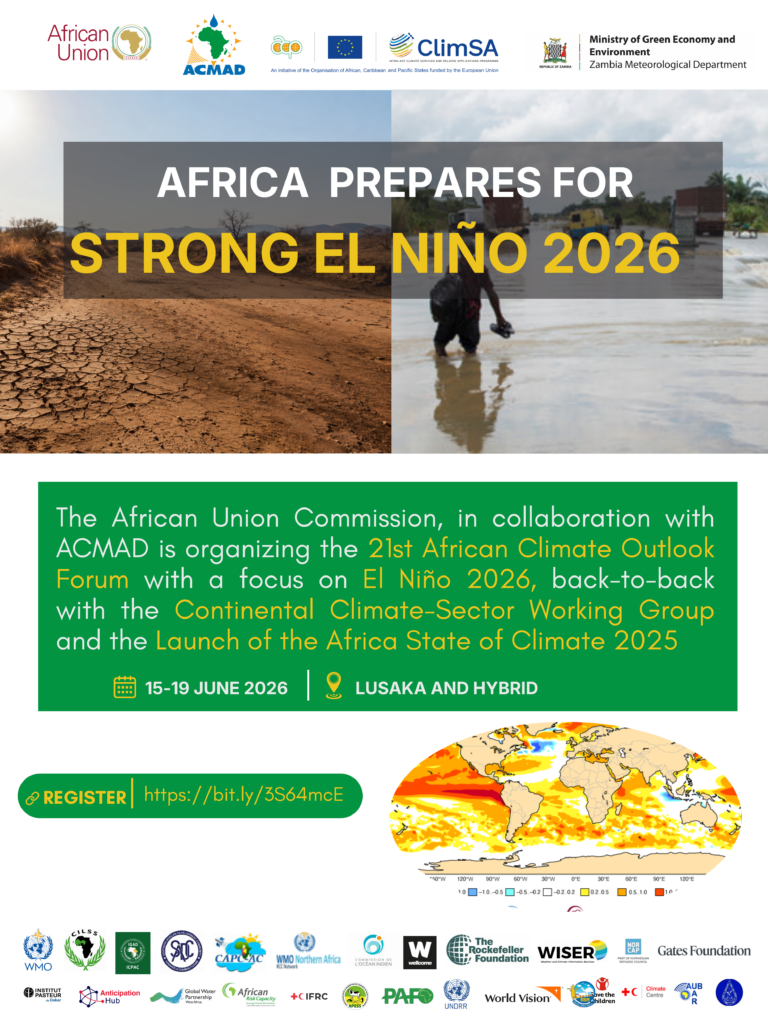
ABOUT ACCOF-21 :
Africa is increasingly exposed to climate variability and extreme weather driven by global systems like El Niño. The 2015-2016 event, among the strongest recorded, left over 50 million people food insecure as drought devastated Southern Africa and floods struck the East. Agriculture collapsed, livestock perished, and ripple effects spread across health, water, sanitation, and education (ref. FAO special Alert 2015, 2012; World Bank, Apr 2018).
The 2023-2024 El Niño, though weaker, revealed new vulnerabilities. Severe droughts and erratic rainfall hit West and Southern Africa, deepening food insecurity, while East Africa endured alternating dry spells and floods. Coastal regions faced record sea level anomalies, storm surges, erosion, and saltwater intrusion that threatened communities and infrastructure. This episode also fuelled global heat, making 2024 the hottest year on record.
Together, these events underscore a new reality: El Niño now compounds the impacts of climate change, amplifying both land and ocean hazards. Africa faces repeated shocks to food systems, water resources, and livelihoods, alongside rising risks from global ocean warming (in particular Indian, Atlantic and Antarctic Ocean) and coastal flooding.
Global Forecasting Centres project a strong El Niño in late 2026, with peak intensity expected between October and December. Africa’s Regional Climate Centres (RCCs) discussed the forecast of the event during a webinar session mid-May 2026. While each episode is unique, Africa must urgently strengthen preparedness and mitigate impacts, especially across climate-sensitive sectors and among vulnerable groups such as children, women, and persons with disabilities. As widely noted, “The question is no longer whether El Niño will occur, but what actions must be taken to reduce its impacts.”
RCCs are central to generating, interpreting, and disseminating climate information. Over the past four years, collaboration among RCCs has deepened, with more structured engagement of governments, disaster managers, agriculture and water stakeholders, health institutions, media, humanitarian actors, and local communities. Yet, sectoral working groups, critical to anchoring User Interface Platforms (UIPs), remain not well constituted. Their establishment, strongly recommended by the African Union Commission (AUC) at the 6th STC on Agriculture, Rural Development, Water and Environment, is a priority to ensure ACCOF products translate into actionable, sector-specific services.
In this context, ACMAD, as WMO’s designated continental RCC, together with the AUC through the ClimSA Programme and other RCCs, will convene the 21st African Continental Climate Outlook Forum (ACCOF-21) alongside the continental working group and UIP workshops from 15-19 June 2026 in Lusaka, Zambia.
This forum will unite RCCs and key stakeholders to assess the projected El Niño impacts, harmonize regional outlooks, share lessons, and co-develop actionable climate services and early warnings tailored to vulnerable communities. It will also advance the formal establishment of Continental User Working Groups, ensuring synergy between AUC, RCCs, RECs, sectoral institutions, and user communities.
FORUM OBJECTIVES :
The overall objective of the forum is to strengthen continental coordination, climate service delivery, and user preparedness for the anticipated 2026 El Niño event.
The specific objectives are to:
● Present and discuss the latest forecasts and projected impacts, building on lessons learned from past episodes.
● Facilitate dialogue between climate information producers and users across priority socio-economic sectors.
● Enhance user capacity for preparedness and early action for 2026 ENSO.
● Advance the formal establishment of Continental Working Groups, including governance, membership, and Terms of Reference.
● Define guidelines for producing Continental Sectoral Climate Bulletins.
● Initiate drafting of a Continental White Paper on Climate Services for Priority Sectors, consolidating lessons and institutional frameworks.
EXPECTED RESULTS :
The expected results of the Forum include:
- Enhanced collaboration among RCCs and alignment of continental climate service delivery.
- Structured dialogue between climate information providers (RCCs) and socioeconomic sectors (RECs) to improve preparedness.
- Improved user ability to interpret and apply seasonal forecasts for early action.
- Formal establishment of Continental Working Groups with agreed governance and Terms of Reference.
- Guidelines for Continental Sectoral Climate Bulletins and coordinated messaging during Extreme events.
- Drafting of a Continental White Paper on Climate Services for Priority Sectors.
- Identification of region-specific risks, priorities, and opportunities for tailored early warning.
- A harmonized approach to transforming seasonal outlooks into sector specific advisories and early warnings.
Contact
For more inquiries, please contact this following link: contact@acmad.org