
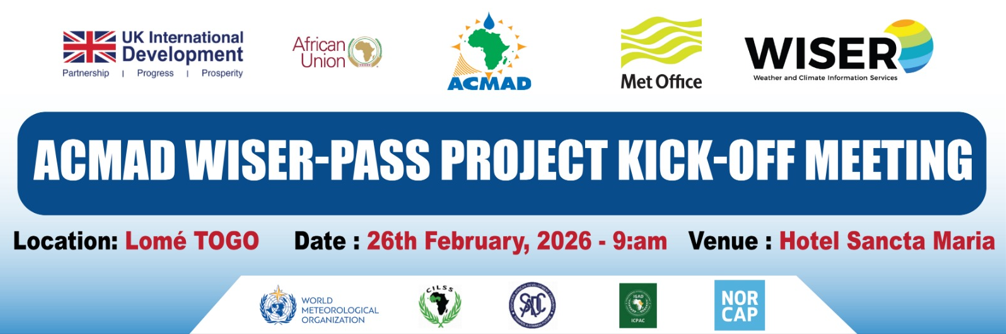
ACMAD-WISER PASS PROJECT KICK-OFF MEETING

DATE
February 26th, 2026
Location
Lomé TOGO, Hotel Sancta Maria

About Meeting
The African Continent, with abundant diverse ecosystems, rich cultural heritage, and growing populations, faces disproportionate burdens and risks arising from climate change-related weather events and patterns. These events cause massive humanitarian crises with detrimental impacts on agriculture and food security, education, energy, infrastructure, peace and security, public health, water resources, and overall socioeconomic development across the continent.
Climate change projections for Africa indicate a future marked by increased climate extremes, posing significant challenges across the continent. As global temperatures continue to rise, Africa is expected to experience more intense and frequent altered precipitation patterns leading to both severe droughts and heavy rainfall events, and an increase in the occurrence of extreme weather events such as cyclones and floods.
The increasing frequency and intensity of climate-related disasters have underscored the urgent need for effective early warning systems (EWS) and climate information services (CIS) to reduce disaster risks and build community resilience. Vulnerable populations often face limited access to actionable early warning information, especially at the last mile, where the impacts of disasters are most severe. Locally led, innovative approaches are essential to bridge this gap, enabling communities to better anticipate and respond to multi-hazard risks through impact-based forecasting.
Although the African NMHSs provide information on weather and climate, the quality and format of these services do not meet the real needs of early warning, and losses and damages due to extremes are still significant. It is therefore urgent to better define and specify the needs for warning products and services to ensure community resilience and risk management, and these products and services for the specific needs identified should be developed, validated, and made operational.
Seasonal climate outlooks are essential planning tools across Africa, where the climate is seasonal. They inform when farmers plant, what seed varieties they choose, how governments plan for droughts or floods, and when health systems mobilize for potential disease outbreaks. Yet, despite their importance, these forecasts often fall short of their potential, particularly for those operating at the local level (small farm holder), where decisions are most sensitive to climatic variation.
Regional Climate Centre, as well National Meteorological and Hydrological Services are facing challenges such as the disconnection between science-based information and the actual decision-making process (i.e., how information is presented to users?), gap between local climate action needs and the decision-making processes that govern the functioning of climate outlook forums and other relevant spaces for forecast generation and translation (i.e., what are the operational arrangements to ensure timely delivery?).
These challenges are met with limited operational capacity to downscale regional forecasts into nationally and locally relevant ones, including for those variables that are most relevant to the decision maker. According to the WMO report, few African National Meteorological and Hydrological Services (NMHSs) have the operational capacity to translate regional forecasts into actionable local guidance. As a result, national bulletins often reach end users too close to the planting season, leaving little time to adjust plans, procure inputs, or prepare for risks. The cost of this gap is tangible. In Africa, with rainfed agricultural systems, each week of planting delay, often due to late or unclear seasonal information, can reduce crop production.
The WISER program aims to deliver transformation in the generation and use of co-produced weather and climate services to support decision making at local, national, and regional levels, building resilience to the impacts of climate change.
The Pan-African Seasonal Strengthening (PASS) project aims to strengthen the ability to produce and communicate seasonal information at regional, national and sub-national levels, and seeks to work with WMO RCCs across Africa to improve the production and communication of the seasonal forecast information.
The ACMAD WISER-PASS project is a collaboration between Met Office and ACMAD. In line with the WISER-PASS Objective, the project will significantly enhance the existing system, by strengthening coordination, introducing shared digital infrastructure, and deepening collaboration across RCCs, NMHSs, and ACMAD.
The ACMAD component aims also to accelerate the delivery of locally actionable climate information, while supporting institutional capacity development, including for ACMAD’s role in facilitating methodological coherence and regional partnerships.
Furthermore, the project will enhance the Meningitis Early Warning System (MEWS) to support improved health-sector decision-making and anticipatory action across Africa.
In this framework, ACMAD in collaboration with UK Met Office is organizing a kick-off meeting to officially launch the ACMAD WISER-PASS Project, the meeting will be opportunity to present the project’s objectives, scope of work, implementation framework, and the respective roles and responsibilities of collaborating partners. The Meeting will be held back-to-back with the PRESAGG in Lome, Togo on February 26th, 2026.
Objectives:
The kick-off meeting will mark the official launch of the project and will ensure all partners have a common understanding of:
– Project objectives, expected deliverables, and timelines;
– Technical requirements and integration approach for the forecast component;
– Roles, responsibilities, and coordination mechanisms;
– Communication, reporting, and review processes
Expected Outcomes:
The kickoff meeting will facilitate a common understanding of the WISER-PASS project’s goals, structure, and implementation approach, it will be also the opportunity for partners to express their commitment and readiness to proceed, with clear engagement collaboration and coordination mechanisms.
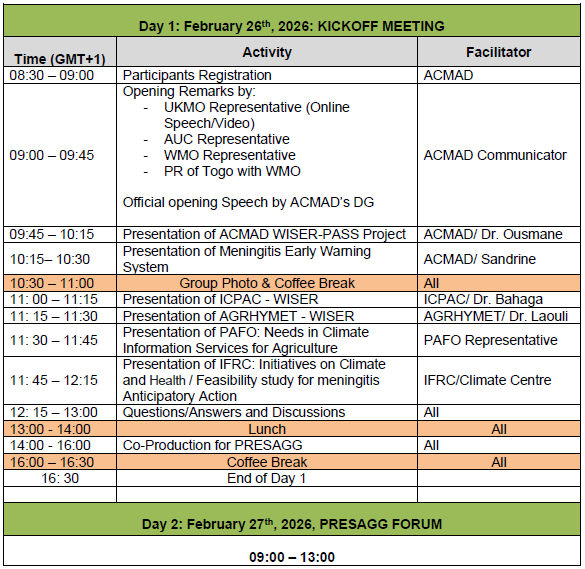
AGENDA
Contact
For more inquiries, please contact this following link: contact@acmad.org